Erectile dysfunction is a useful example of how differently Western medicine and Chinese medicine can look at the same patient.
As a pharmacist, I was trained to think in terms of physiology, pharmacology, disease states, receptors, blood flow, hormones, medications, adverse effects, and drug interactions. As a Chinese herbalist, I was trained to ask a different set of questions. Why is this symptom appearing in this particular patient? What else changed around the same time? How is he sleeping? How is his energy? Is he under more stress? Has his digestion changed? Is his libido actually lower, or is desire still present but performance inconsistent? Is he feeling unusually cold or hot? What is happening with urination?
After working with both systems, I no longer see these as competing ways of thinking. I think they are different questions, and often both are worth asking.
What Western Medicine Does Very Well

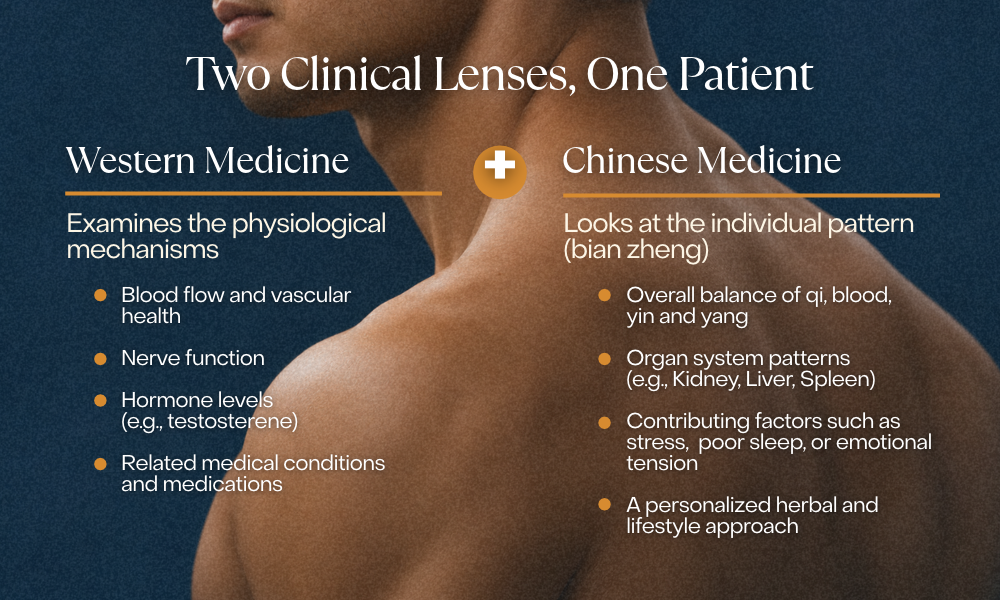
From a biomedical perspective, erectile function depends on a coordinated interaction among the vascular, neurological, hormonal, and psychological systems. A conventional evaluation may look at cardiovascular health, diabetes, testosterone, medications, neurological conditions, stress, depression, sleep, and other contributing factors. This is one of the great strengths of modern medicine. It is very good at identifying specific mechanisms and treating them directly. Medications such as sildenafil and tadalafil can be highly effective in improving erectile function.
For many men, these medications work extremely well but it is important to understand what they are doing. They improve the physiological response involved in achieving and maintaining an erection. They do not necessarily correct the reason the patient developed erectile dysfunction in the first place. If the underlying issue is vascular disease, diabetes, low testosterone, a medication effect, chronic stress, or another health problem, that still deserves attention. A medication can be very effective and still be treating the symptom rather than the entire clinical picture, and that distinction matters.
What Chinese Medicine Asks Differently
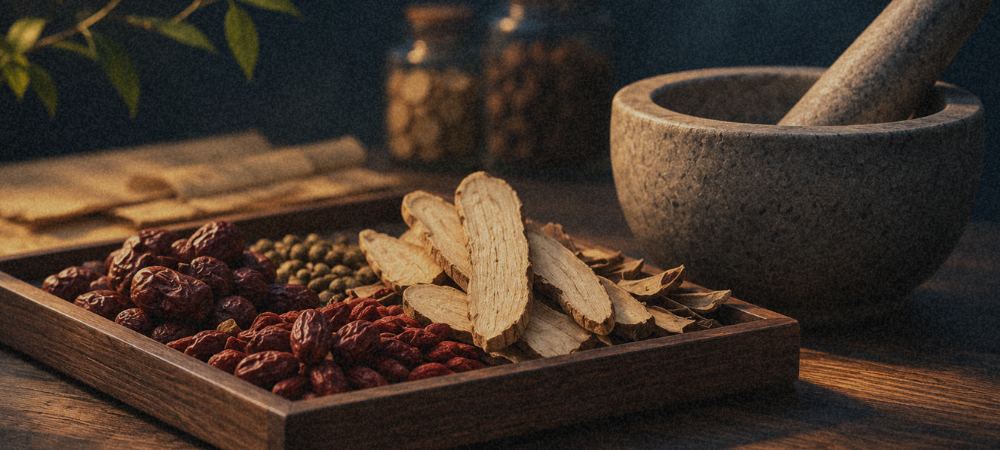
Chinese medicine begins from another place. Instead of stopping at the diagnosis of erectile dysfunction, we ask how the symptom fits into the rest of the patient. When I teach students, one of the mistakes I warn them about is treating the disease name instead of the person.
Two men can both walk into the clinic with ED and require completely different herbal strategies. One man may have a gradual decline in libido and erectile function along with fatigue, poor sleep, sensitivity to cold, and reduced vitality. Another may have a strong libido and otherwise normal function, but his erections become unreliable during periods of stress, emotional tension, or poor sleep.
In Western medicine, both may be diagnosed with erectile dysfunction. In Chinese medicine, they may represent very different patterns. That is the essence of bian zheng, or pattern differentiation.
The question is not simply: “What herb treats erectile dysfunction?” The more useful question is: “What pattern best explains why this particular man is experiencing ED in this particular way?”
This is one of the philosophical differences I find most useful. In Chinese medicine, the aim is not simply to stimulate an erection. Treatment is directed toward the pattern identified in the patient. If the pattern is addressed successfully, sexual function may improve as part of a broader clinical response. That broader response might include better sleep, improved energy, less stress, changes in digestion, greater vitality, or other improvements depending on the individual.
That does not mean Chinese medicine is somehow “better” because it looks at the whole patient. Modern medicine also evaluates underlying disease very carefully. The difference is more about how the information is organized and how treatment is selected. Western medicine often begins by identifying a specific physiological mechanism while Chinese medicine begins by identifying a pattern across the patient's signs and symptoms. Both approaches can be valuable.
ED Is Not Always a Kidney Deficiency
Another point I emphasize when teaching herbology is that sexual dysfunction does not automatically equal Kidney deficiency. The Kidney system is very important in Chinese medicine and is traditionally associated with reproduction, sexual development, aging, constitutional strength, and jing, or essence. But erectile dysfunction may also involve patterns associated with the Liver, Heart, Spleen, qi, blood, yin, yang, dampness, or blood stasis. This matters because the treatment changes with the pattern. A formula that is appropriate for one man may be completely inappropriate for another man with exactly the same Western diagnosis, that is where individualized Chinese medicine becomes important.
Herbs, Medications, and Safety
People often ask about over-the-counter formulas for vitality, male function, energy, or age-related changes. There is a place for them. Many are designed around common patterns and can be useful when the patient's presentation matches that pattern. The limitation is that they are necessarily general. If the pattern fits, the formula may work quite well but if it doesn’t, the result can be hit-or-miss. That does not mean there is anything wrong with a well-designed OTC formula. It simply reflects the fact that Chinese medicine is traditionally individualized. For a straightforward concern, a general formula may be perfectly reasonable.
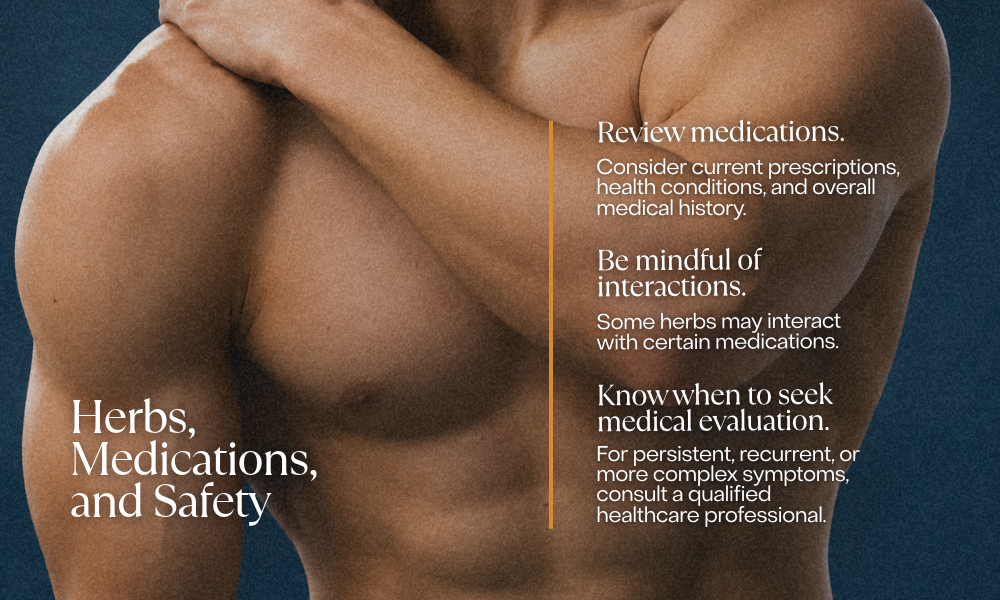
For persistent, recurrent, or more complicated symptoms, I would recommend seeing a licensed Chinese medicine practitioner, particularly one with formal training in herbology. A trained practitioner can look at the broader pattern, consider other medications and health conditions, and decide whether a standard formula, a modified formula, or another strategy makes the most sense.
Chinese herbal medicine should not be practiced in isolation from the rest of a patient’s care. Many men seeking help for ED may already be taking medications for blood pressure, diabetes, cholesterol, depression, cardiovascular disease, or other conditions. Those medications matter when selecting herbal treatment. A qualified practitioner should review the patient’s medication history, consider possible interactions, and recognize when laboratory testing, medical evaluation, or referral is appropriate. “Natural” does not automatically mean appropriate for every patient. That is another reason individualized care matters.
Men sometimes want to know whether ED is physical or psychological. The answer is often both. A man may have mild vascular changes and then develop performance anxiety after several difficult experiences. Another may be under chronic stress, sleep poorly, and also have early metabolic disease. Once anxiety develops around sexual performance, it can reinforce the problem even further. This is why it is rarely useful to dismiss ED as “just psychological,” just as it is incomplete to assume every case is purely physical. The patient has to be looked at as a whole.
This is also where Chinese medicine should not be used as an alternative to appropriate medical evaluation. New, persistent, or worsening erectile dysfunction can sometimes be associated with cardiovascular disease, diabetes, hormonal abnormalities, medication effects, or other underlying conditions. If a man develops sudden ED, chest symptoms, major changes in exercise tolerance, significant pain, urinary changes, or other concerning symptoms, he should be evaluated medically. A responsible Chinese medicine practitioner should know when referral is necessary; and that is not a weakness of Chinese medicine, it is simply good clinical judgment.
Chinese Medicine and Western Medicine Are Not Opposites
I have never found the argument over which system is “better” particularly useful. In China, Chinese medicine and Western medicine are often used side by side and that makes sense to me. Some conditions are clearly better handled by biomedicine. Others may benefit from the individualized, pattern-based approach of Chinese medicine.
Sometimes the most appropriate answer is a prescription medication but sometimes it is an herbal formula. There are times where it is lifestyle change, better sleep, stress management, further testing, or referral. Often it is some combination of these.
The important question is not: “Which system should I choose?” It is: “What does this patient need?” That is ultimately the perspective I have developed from working in both worlds. With erectile dysfunction, I would not ask only, “What can this man take?” I would ask: What changed? Why did it change? What else is happening in his health? What needs to be ruled out? And which tools are most appropriate for this particular patient? For me, that is where Western medicine and Chinese medicine are most useful, not when they compete, but when each contributes what it does best.
Dr. Thomas Leung
Pharm BS., DACM, L.Ac
CEO of Kamwo Herbs
Dr. Thomas Leung, DAOM, BS Pharm, is a practitioner and educator of Chinese herbal medicine with a background in pharmacy. He serves as faculty at Pacific College of Health and Science and is actively involved in advancing clinical standards in herbal medicine, including integrative oncology care. His work focuses on bridging traditional herbal medicine with modern pharmaceutical and quality standards.